

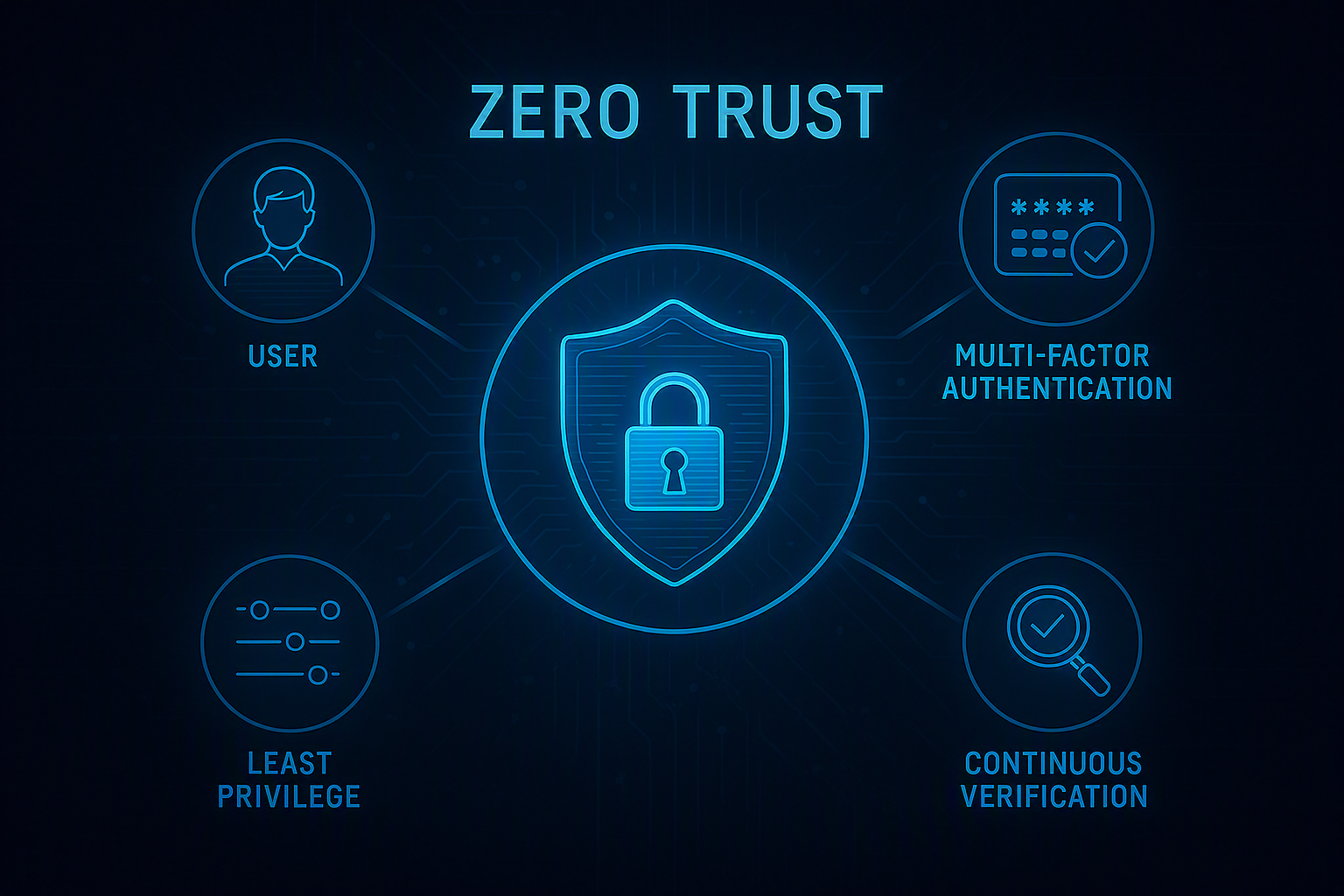
Zero Trust security has emerged as one of the most important cybersecurity frameworks in modern IT environments. Traditional security models relied heavily on perimeter-based defenses—assuming that everything inside the network could be trusted. However, with the rise of cloud computing, remote work, and mobile devices, this model has become outdated.
Zero Trust operates on one fundamental principle: “never trust, always verify.” This means that no user, device, or application is automatically trusted, even if it is inside the network. Every access request must be authenticated, authorized, and continuously validated.
One of the main drivers behind Zero Trust adoption is the dissolution of the network perimeter. Employees now access company resources from various locations and devices, often outside traditional corporate networks. This has made it easier for attackers to exploit weak points and gain unauthorized access. By implementing Zero Trust, organizations can ensure that access is granted only after strict verification.
Identity plays a central role in Zero Trust. Instead of relying solely on network location, security decisions are based on user identity, device health, and contextual factors. Multi-factor authentication (MFA) is a key component, requiring users to provide additional verification beyond passwords. This significantly reduces the risk of credential-based attacks.
Another critical aspect is least privilege access. Users are given only the minimum level of access required to perform their tasks. This limits the potential damage if an account is compromised. For example, an employee in finance should not have access to engineering systems unless absolutely necessary.
Micro-segmentation is also a core principle of Zero Trust. Instead of having a flat network, systems are divided into smaller segments, each with its own security controls. This prevents attackers from moving laterally within the network. Even if one segment is breached, others remain protected.
Monitoring and analytics are essential for effective Zero Trust implementation. Continuous monitoring helps detect unusual behavior, such as login attempts from unfamiliar locations or access requests outside normal working hours. Advanced tools like AI-driven analytics can identify patterns and respond to threats in real time.
Implementing Zero Trust is not a one-time project but an ongoing process. Organizations must continuously assess their security posture, update policies, and adapt to new threats. This requires collaboration between IT, security teams, and business units.
Despite its challenges, Zero Trust offers significant benefits. It improves security, reduces attack surfaces, and enhances visibility across the IT environment. As cyber threats continue to evolve, Zero Trust is becoming a standard approach for protecting sensitive data and systems.
In conclusion, Zero Trust represents a shift in how organizations think about security. By focusing on identity, access control, and continuous verification, it provides a robust defense against modern cyber threats.